

The diamond, known as "a woman's best friend", continues to fascinate and inspire with its variety of colors and unique qualities. In the fascinating world of diamonds, green shines as a symbol of rarity and mystery. In this article, we will explore this wonderful gemstone, revealing its origins, distinctive characteristics, and the fascination it holds for jewelry lovers around the world.
The origin and formation of the green diamond
Due to their rare nature, green diamonds are significantly more expensive than colorless diamonds of similar size. Unlike other diamond colors, such as blue, pink or yellow, the green color of the diamond is not due to the presence of impurities, but to the unique natural processes during its formation and the presence of specific elements in the chemical composition of the diamond, such as nitrogen, nickel or the uranium. The amount and type of element present determines the intensity and green hue of the diamond.
The green diamond has been known for centuries, being valued by various cultures for its beauty and symbolism. Its vibrant green color evokes feelings of freshness, vitality and harmony, making this gemstone a popular choice for engagement rings and other significant jewelry. Some of the most famous green diamonds include the "Dresden Green", a 41-carat diamond with a VS1 clarity grade. It was discovered in the mines of the Golconda region of India, famous for their production of diamonds of the highest quality, and is now part of the collection of the Green Treasury in Dresden.
Green diamonds - characteristics
Beyond beauty, this gemstone has unique characteristics that set it apart from classic colorless diamonds. Here they are:
Green Color: The key to a diamond's green color is the presence of specific chemical elements in its crystal lattice. Nitrogen, nickel or uranium, in varying concentrations, give rise to the fascinating shades of green.
Shades and Intensity: Green diamonds are found in a wide range of secondary shades, such as yellow-green, brown-green, blue-green or gray-green. The most valuable specimens are diamonds with an intense and uniform green color without areas of inconsistent color.
Treated Green Diamonds: Sometimes the green color can be achieved through artificial treatments such as irradiation or exposure to high temperatures. These diamonds have a lower value than natural green diamonds.
Clarity: Similar to white diamonds, clarity is an important factor that influences the value and beauty of a green diamond. Inclusions (internal imperfections) and defects (external cracks) can affect the brilliance and play of light of the stone. Green diamonds with high clarity are rarer and more valuable.
Cut: To maximize the play of light and bring out the green, the cut of the diamond is crucial. Popular cuts for green diamonds include radiant, oval and emerald. These cuts optimize light reflection and accentuate the green hue.
Carat: As with other diamonds, the size, expressed in carats, influences the price. Large green diamonds are extremely rare, which increases their value exponentially.
Rarity: Green diamonds are much rarer than white diamonds. This rarity, combined with high demand, contributes to their premium price.
Physical properties: The green diamond, like any diamond, is an extremely hard stone with a hardness of 10 on the Mohs scale. This high hardness gives it excellent scratch resistance.
The refractive index of the green diamond is similar to that of the white diamond, resulting in a spectacular play of light.
How is the quality of a green diamond determined?
Similar to white diamonds, the quality of green diamonds is based on the well-known "4 C's" - carat, clarity, color and cut. Other factors that determine quality are fluorescence, polish, symmetry, purity and color intensity, the latter being the most important.
The international color grading scale for green diamonds is:

Green diamond engagement rings
Green diamond engagement rings are a suitable choice for those who are looking for something more than just beauty; they symbolize rarity, power and eternal love. When expertly crafted, they add a distinctive touch and personality to a classic piece of jewelry. Whether it's a simple setting or an elaborate design, the green diamond is always the center of attention, exuding an aura of mystery and sophistication.
The most popular green diamond engagement rings from the Valmand collections are:
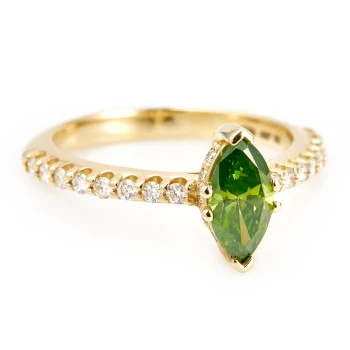
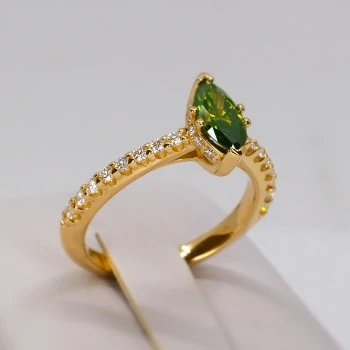
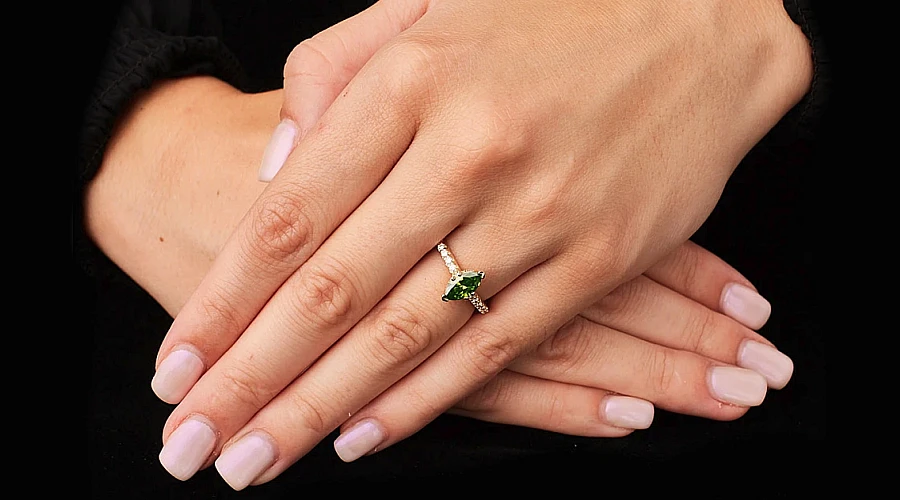
Marquise Green Diamond and Colorless Diamond Engagement Ring - The intense and vibrant hue of the center diamond is enhanced by the warm gold color and diamonds on the sides.
Halo Pave Green Diamond and Colorless Diamond Engagement Ring - The halo of colorless diamonds surrounding the green diamond accentuates its beauty and brilliance, creating a light-enhancing and reflective effect.
How much is a green diamond?
Because they are extremely rare, green diamonds are some of the most expensive gemstones in the world. At the same time, the price of a green diamond is also given by the complex process through which it was formed, size and shape.
Approximate prices: To give you a general idea, fancy light green diamonds can start at $50,000 per carat, and fancy vivid ones can exceed $300,000 per carat.
Record prices: For exceptional specimens, prices can reach astronomical sums. For example, the famous "Aurora Green Diamond" of 5.03 carats, with a fancy vivid green color, sold at auction for more than 3.3 million dollars per carat.
Conclusion
As a symbol of nature and elegance, the green diamond shines in the jewelry world, bringing a touch of distinction and charm to any creation. Whether admired in its rough form or encrusted in an engagement ring, the green diamond remains one of the most precious and remarkable treasures on earth.