





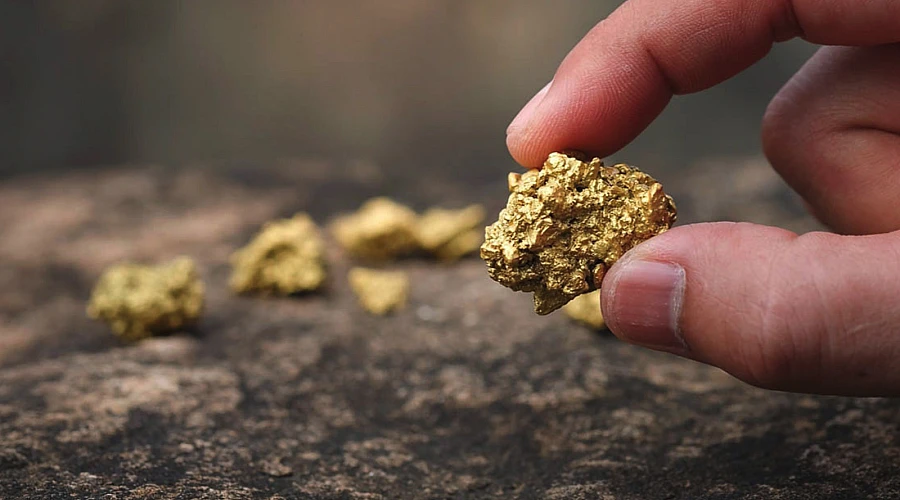
Considered not only a precious metal but also a representation of wealth and power, gold, also referred to as the "metal of kings", has been prized throughout history for its impressive luster, beauty, durability and value. It has been and continues to be used in a variety of fields, from jewelry creation to the manufacture of electronic components. Today we're going to show you ten interesting facts about gold that you probably didn't know.
1. The world's largest gold bar weighs 250 kg. It is in the Toi Gold Museum in Japan. It was manufactured by Mitsubishi Materials Corporation, a subsidiary of Mitsubishi, and received an official certificate from Guinness World Classifying it as the "largest gold bar". It is currently valued at over $15 million.
2. Australian scientists discovered that eucalyptus leaves contain gold. Eucalyptus roots can reach depths of up to 40 meters underground in search of water. Since gold deposits are found in water and underground, the eucalyptus tree absorbs the microscopic gold particles, which are then transferred to the leaves through photosynthesis.
3. The first known gold coin was created in Lydia (the ancient region where Anatolia is today) around 600 BC. This coin was called the "stater" and marked the beginning of the use of gold as currency. The Lydian stater was a gold disc with a specific gravity and an engraved design. During the reign of Croesus, these coins were made from electrum, an alloy of gold and silver found in the rivers of the region.
4. Gold is edible and is mainly used in luxury gastronomy in the form of very thin leaves to decorate food. This type of gold is pure, 23 or 24 carat. Being considered "biologically inert", meaning it passes through the digestive tract without being absorbed by the body, edible gold cannot harm health.
5. Olympic medals contain 1.34% gold, which is about 6 grams. The only medals made entirely of gold were those at the 1912 Stockholm Olympics.
6. Since the 1960s, NASA has been using thin gold foils to protect space equipment from excessive solar radiation. They reflect radiation and prevent equipment from overheating.
7. Pure, 24-carat gold melts at 1064 degrees Celsius, and its boiling point is 2856 degrees Celsius. Also, pure gold is so soft that it can be bent with the free hand.
8. The chemical symbol for gold is "Au". The abbreviation comes from the Latin "aurum", meaning "bright dawn".
9. It is estimated that about 78% of the world's gold (freshly mined and recycled) is used in the manufacture of jewelry.
10. Most of the gold on Earth comes from meteorites that hit the Planet about 200 million years ago.
Gold jewelry markings
The markings used for gold jewelry are:
- 9 carat gold (9K) - mark 375 (purity 37.5%)
- 10 carat gold (10K) - mark 417 (purity 41.7%)
- 12 carat gold (12K) - mark 500 (purity 50.0%)
- 14 carat gold (14K) - mark 585 (purity 58.5%)
- 18 carat gold (18K) - mark 750 (purity 75.0%)
- 20 carat gold (20K) - mark 833 (purity 83.3%)
- 22 carat gold (22K) - mark 916 (purity 91.6%)
- 24 carat gold (24K) - mark 999 (purity 99.9%)
Of course, a piece of jewelry that contains more fine gold (for example, if it is marked 22K or 18K) will always be more expensive. You should also keep in mind that 99.9% pure 24K 999 gold is far too soft to be used in jewelry making, it is found in other forms such as coins or bars.

