





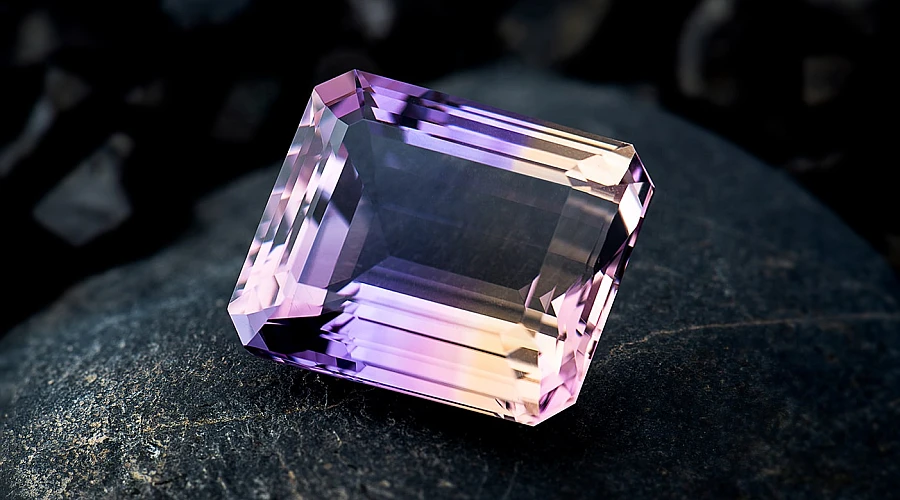
The history of amethyst
The name of one of the most beautiful gemstones comes from the Greek word "a-methystos" which is based on the word "methy" (wine). Another historical source places the origin of the word at "amethustos" which means "one who is not drunk". If we cannot say with certainty what the origin of the name is, one thing is certain: this semi-precious stone that can vary from purple to crimson is one of the most valuable and appreciated varieties of quartz.
As it has been since ancient times, amethyst is worn prominently for its prophylactic functions, being also valued for protecting against sorcery, black magic and dark thoughts. The Greeks believed that amethyst had the power to ward off false friends and thieves, and in international popular culture it is believed that amethyst can transform energy into love, combat stress, and bring a state of peace of mind to anyone who wears it.
Also in Antiquity, amethyst, depending on the religion practiced, had a strong spiritual charge. The Celts considered it the "stone of the Druids", the Buddhists considered it to have purifying properties and the "stone of evolution on the steps of spirituality", and in the territory of today's India it was the stone of the Brahmins.
Also in the past it was also considered the episcopal stone, being given to Christian bishops at the investiture. The priests who wore it were protected from vices and with its help they kept their vow of chastity. For most cultures it represented piety, humility and sincerity.
The American Gemological Society decided in 1912 that amethyst was the stone of February and that it represented the first six years of marriage.
Romantics who don't shy away from showing their feelings on Valentine's Day should know that throughout history there has always been a connection between the saint and amethyst, due to its purifying power and ability to transform everything into love and feelings of love.
Legend has it that the beautiful Amethysta did not want to respond to the insistent advances of Bacchus, the god of wine, and Diana, the goddess of the hunt, decided to turn her into a pure quartz crystal over which Bacchus poured wine to give it a purple hue.
Another version of the stories has Dionysus as the main character. This one, nervous because of the insults received from a mortal, promised that the first person who gets in his way will be torn apart by tigers. In front of him appeared Amethystos who was going to make offerings on the altar of the goddess Artemis. Wanting to save her from Dionysus's tiger, he managed to save her in a pure quartz statue, colored after Dionysus poured wine over her.
Types of amethyst
The quality of amethyst differs depending on the geographical area of origin, but the best quality is completely transparent amethyst.
There are only two types of amethyst – oriental (purple sapphire) – which has the characteristics of sapphire and ruby. The second variety is a form of quartz and is called true amethyst.
In its natural state it has a purple color with transparent or white inserts. It ranks 7th on the hardness scale. You can recognize it by its glassy luster, but it should be noted that the structure is different from other crystals of the same weight and hardness. The crystal has an interesting reaction to temperature changes which is why the color becomes paler when exposed to heat. The main reason why wearing amethyst jewelry to the beach is not recommended.
Uniformly colored amethysts are incredibly rare and only a few countries can boast such gems: Brazil, Madagascar, Germany, Russia and Sri Lanka.
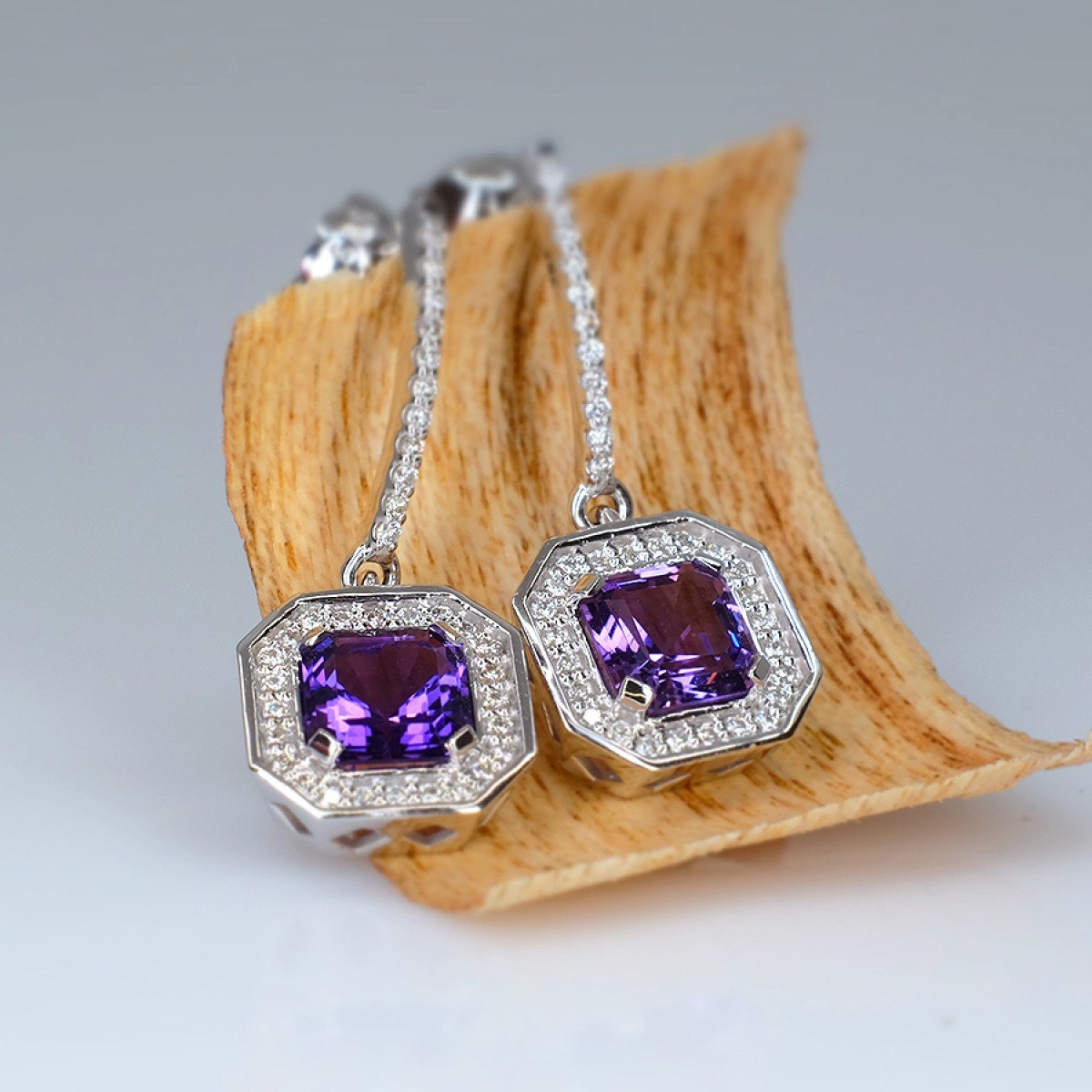
Gold earrings with amethysts and diamonds
The colors of amethyst
According to the legends, each color has a certain property.
Purple Amethyst – brings light, love and connects heart and speech. Some believe that a lighter purple stimulates brain activity;
Marbled Amethyst – stimulates the immune system and helps find solutions to any problem. Many also use it to relieve stress;
Pineapple amethyst – stimulates imagination and creativity;
Lilac amethyst – extracted right from the Maramureș area, has a high vibration and the power to harmonize;
Green amethyst - also known as Prasiolite (from the Greek "prason" - leek and "lithos" - stone) has the power to calm.


