





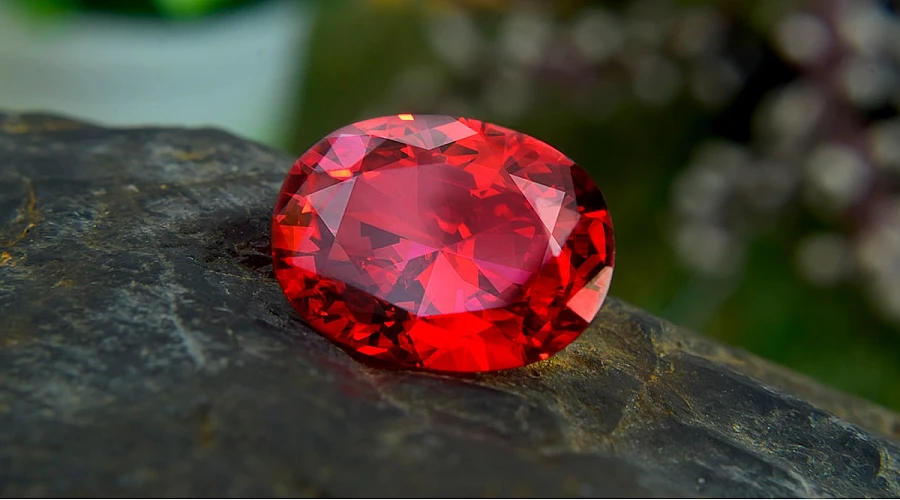
Ruby is an extremely strong gemstone with a hardness of 9.0 on the Mohs scale, just below diamond.
The word "ruby" comes from the Latin "ruber" meaning red. Ruby is a hard, red variety of corundum, and all other color varieties of corundum are called sapphire. Its gorgeous color is due to traces of chromium.
Ruby must meet certain standards to fall into the ruby category, otherwise it is labeled as pink sapphire. Natural rubies contain imperfections. These imperfections are inclusions of rutile needles called "silk", and they play an important role in the detection of artificial rubies. In fact, inclusions in a ruby prove authenticity and reveal the beauty and individuality of each stone.
Color is the most important determinant of its value. Darker and clearer colored rubies are the most sought after, but also the most expensive. There are three aspects of a ruby's color that are considered, hue, saturation and tone. Hue refers to the color of the ruby as we see it. Saturation determines the visibility of the color and hue implies the purity of the color. If it is a pure tone, there will be no secondary colors. If it is not a pure tone, it may include one or more secondary shades, such as pink, purple, or orange.
How the ruby is seen in the world
"A drop of the heart's blood of Mother Earth" is how the ruby is described in the East. Indians call ruby "Ratnanayaka", meaning "master of precious stones". The Hindus later called the ruby "the king of precious stones". In India, those who donated rubies to honor Krishna were assured of rebirth as an emperor in a future life. Hindus consider light colored rubies suitable for women and darker colored rubies for men.
In the Middle Ages, the ruby was regarded as a stone of prophecy. The stone was believed to darken when danger was near. Solomon described the wisdom of God's judgment as surpassing the most valuable and precious earthly material - the Ruby.
In Asia, the Hindus considered rubies to be the most valuable gemstone. Rubies were also integrated into the caste system through their purity.
In a story by the explorer Marco Polo, the Chinese emperor Kublai Khan travels to Sri Lanka and meets the king of Ceylon. Emperor Kublai Khan is fascinated by the abundant rubies found in the region and offers to exchange an entire city for one ruby stone.
Beginning in the 13th century, many British monarchs used rubies in their coronation rings. From James VII to Queen Mary, rubies were a symbol of lineage, wealth and success.
Provenance rubies
The finest rubies come from the Mogok region of Burma, but also from Thailand, today's main source for rubies. Thai rubies tend to be slightly darker in color. Ceylong Island, called the "island of precious stones", has also long been famous for its rubies, which have a lighter shade. Marco Polo once said that no other place had rubies as beautiful as those of Ceylon. Rubies also come from India, Tanzania, Madagascar, Russia, Sri Lanka, Cambodia, Kenya, Mexico, Afghanistan and North Carolina and Pakistan. Pakistan yields rubies of excellent color, only less frequently than from Mogok.
Ruby – therapeutic properties
Ruby is considered the stone of love, energy, passion, power and lust for life. Like no other gemstone in the world, the ruby is the complete symbol for strong feelings. The ruby is said to restore the vital force, increase energy and vigor. Ruby intensifies emotions and heightens passion. It can be used as a talisman to bring wealth, joy, love, sexual vigor and strength.
Ruby also enhances strength, confidence and enthusiasm. It is also a motivational tool to help you accomplish tasks. It can strengthen and energize the heart chakra, opening blocked channels so you can transmit and receive love, courage, confidence. If used on the base chakra, ruby can act as an aphrodisiac.
The ruby brings peace to the owner, chases away scary dreams and helps resolve disputes. It maintains a clear mind, increased focus, motivation and brings a sense of power to the wearer, self-confidence and determination. Chinese culture believes that red is the luckiest color. It is the favorite gem of lovers, inspiring more emotions than almost any other stone, making it the perfect gift for an engagement or Valentine's Day.
Famous Rubies
Liberty Bell Ruby - the largest mined ruby in the world, found in East Africa in the 1950s. It weighs four kilograms, it is eight and a half thousand carats. The ruby carved into a miniature form of the Liberty Bell is surrounded by 50 white diamonds. The ruby was stolen from Stuart Kingston Jewelers in Wilmington, Delaware during the 2011 robbery and has never been recovered.
DeLong Star Ruby - weighs 100.32 carats and is in the New York Museum of Natural History. The ruby features a 6-pointed star and was named after Mrs. Edith Haggin de Long, who purchased the stone in 1937 from Martin Leo Ehrmann, the renowned gem collector and dealer.
Neelanjali Star Ruby. It weighs 1,370 carats and features an unusual asterism with 12 points and two stars. A ruby is known as a star ruby if it contains an asterism (distinctive star-shaped light refraction) in the gem. He is said to be safe in Bangalore, India.
The Graff Ruby - Weighing 8.62 carats, the ruby set records at Sotheby's Geneva Magnificent Jewels and Noble Jewels auction in November 2014, selling for over $8 million.
Sunrise Ruby - is the most expensive "pigeon's blood" ruby in the world. The 25.59 carat certified untreated ruby set in a Cartier ring and set between heptagonal diamonds weighing 2.47 carats and 2.70 carats. It is considered among the rarest of all gemstones. It has natural, richly saturated color, high clarity and shine, finely proportioned cut and shape. Sold for more than $30 million, it was a world record not only for a ruby, but for any colored gemstone at auction.
The Carmen Lucia Ruby - This spectacular 23.1 carat ruby, set in a platinum ring with diamonds, is one of the finest and largest rubies known. The stone was mined from the legendary Mogok region of Burma in the 1930s. The ring was donated to the Smithsonian by businessman and philanthropist Peter Buck in memory of his wife Carmen Lúcia.
Caring for ruby jewelry
A piece of ruby jewelry (ring, earrings, pendant) can be cleaned once or twice a week to keep it sparkling. Although rubies are durable, you should not use scrubs, abrasives, harsh chemicals, scrubs, or other cleaning products. The best way to clean a ruby gem is to use mild cleaning ingredients. As with other gemstones, gentle cleaning with soap and water is sufficient. Then, wipe the ruby with a soft, clean cloth or lay it out on paper to dry naturally. So, occasional cleaning and minimal maintenance will keep your rubies sparkling for years.
Where do you buy ruby jewelry ?
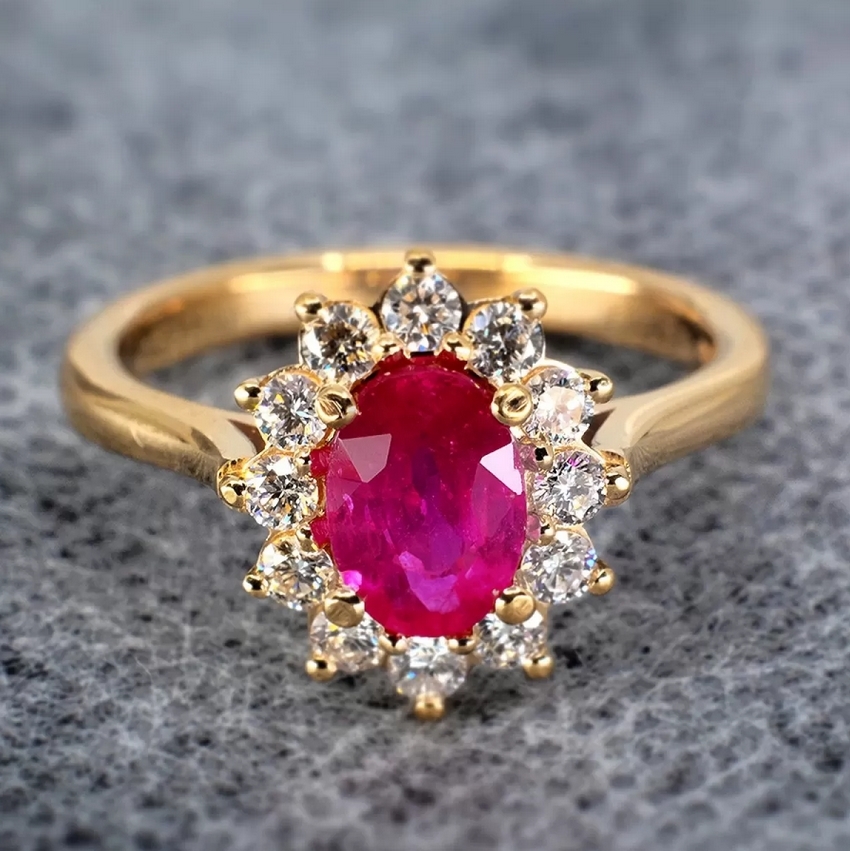
Always buy jewelry from reputable sources that you can check beforehand. Valmand is the perfect place to purchase gemstone jewelry after browsing through the impressive collection of engagement rings, gift rings, wedding rings, earrings, pendants or necklaces.
Valmand's ruby jewelry collection is defined by attention, care to detail, color and sophistication. You cannot remain indifferent to the beauty of a flawless ruby set in a fabulous gem. Consult our specialists or schedule a visit to the store and make the best choice.
